Key Insights from Ann Arbor on Website Governance and Digital Trust
Author: Mary Frances Coryell, CGCIO
Mary Frances Coryell stands at the forefront of government technology as Chief Revenue Officer at Citibot, an AI-powered chat solutions leader serving government agencies nationwide. She brings nearly a decade of experience driving municipal digital transformation and fostering trust between governments and residents. Coryell's work has facilitated data-driven improvements across California and beyond, earning recognition for advancing innovation in resident engagement, accessibility, and operational efficiency.
Key Summary
Ann Arbor’s experience shows that modern government websites are not just publishing platforms. They are service environments that shape how residents judge clarity, responsiveness, and trust.
This white paper examines the lessons behind Ann Arbor’s work with Govstack and Citibot, with particular focus on content readiness, administrative efficiency, and the kind of long-term partnership that helps digital modernization succeed.
Key Conclusions
The strongest lesson from Ann Arbor is that better digital outcomes start with better content.
The second is that successful modernization depends on reducing administrative burden for staff, not adding more complexity.
The third is that the most durable projects are built with trusted partners who stay engaged after launch and help government agencies improve over time.
Key Quote
“Optimize your content first. That is what made the Govstack transition smoother and gave Citibot the right information to deliver accurate answers.” — Kevin Eyer, Technology and Change Manager, City of Ann Arbor
Watch the webinar, “How Ann Arbor Brings Government Technology Together for Residents,” to hear Kevin Eyer share his firsthand experience with Citibot and GovStack, and how Ann Arbor is using technology to better connect residents with government services.
Start with the Content
Ann Arbor did not begin with a technology-first mindset. Kevin Eyer made clear that the city spent significant time cleaning up its content before expecting a new CMS or chatbot to perform well.
That preparation included defining ownership for pages and PDFs, improving readability, and structuring information so both residents and digital tools could use it more effectively.
That content-first discipline gave the city a stronger foundation for a smoother Govstack migration and more reliable resident support through Citibot.
It also reflects the same principle behind Citibot Refresh, which helps government agencies identify outdated, inaccessible, and inconsistent website content before those issues weaken resident trust.
In this story, though, Refresh is not the headline. The headline is that clean content made the rest of the modernization effort possible.
Reduce the Burden on Staff
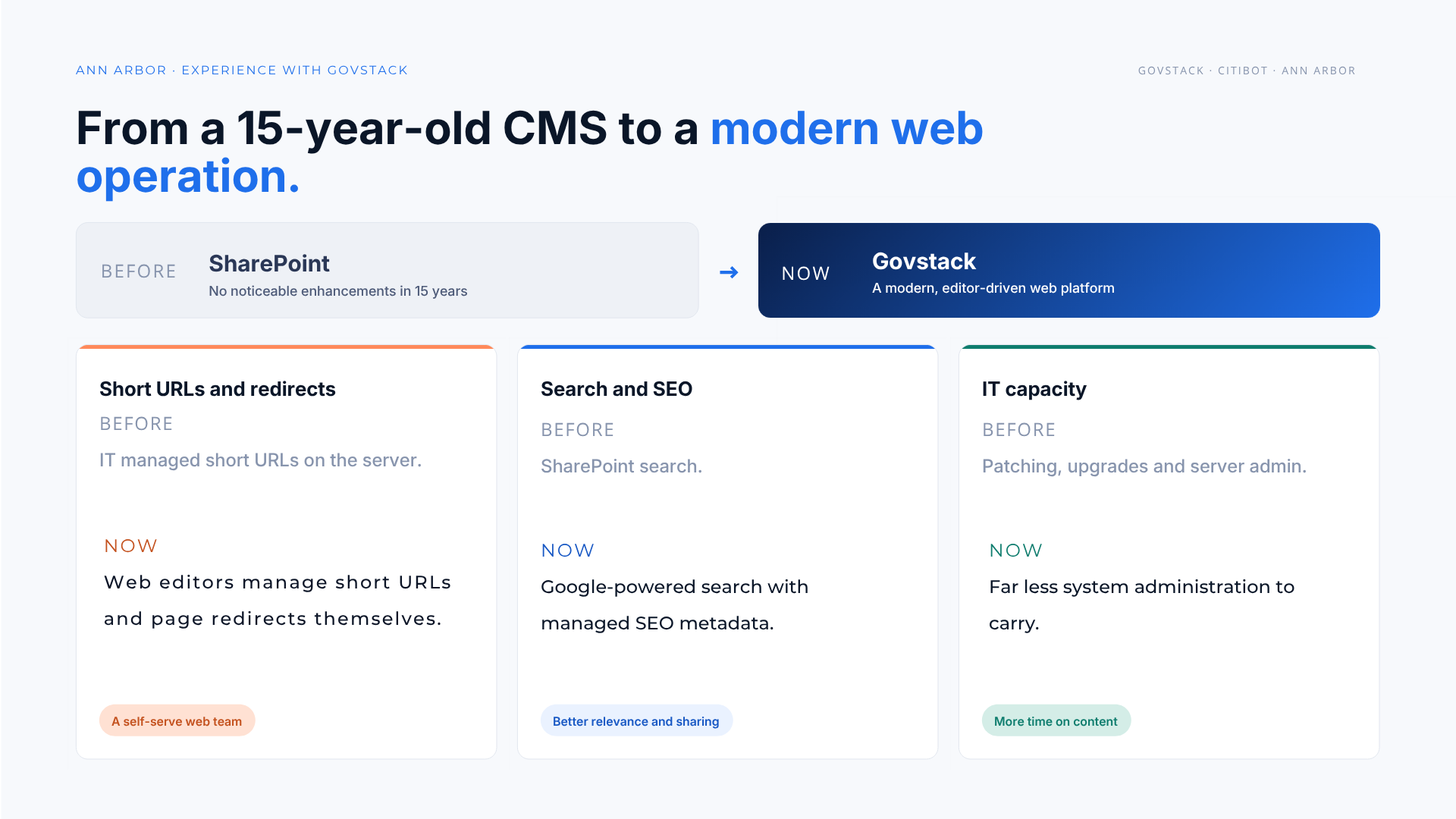
A major reason Ann Arbor moved away from its legacy SharePoint environment was that too much routine website work depended on IT.
Kevin Eyer described a system that had fallen behind modern web expectations and placed the burden of custom programming on internal technical staff for even basic updates.
Govstack helped change that dynamic by giving web content managers better tools to create a modern web experience without relying on custom development for every change.
Features such as easier content management, short URL creation, and redirect handling reduced friction for staff and made it easier to maintain a cleaner resident experience during and after migration.
Kevin also reframed the value of modernization in practical terms. The goal was not simply cost savings on paper. The goal was to redirect staff time toward higher-value work and away from repetitive tasks that should be handled more efficiently through digital channels.
Build Around Real Business Cases
Ann Arbor’s project was grounded in specific business needs rather than abstract enthusiasm for new tools.
Kevin warned against the mindset of “if you build it, they will come” and argued instead for clear goals, documented requirements, and outcomes that could be measured against actual operational problems.
That approach shaped both product selection and implementation. Because the city was managing CMS and chatbot change at roughly the same time, it needed solutions that were loosely coupled, practical to integrate, and flexible enough to support future needs rather than forcing the city into a rigid technology stack.
That decision logic is one of the most transferable lessons in the Ann Arbor story.
Learn from the Small Friction Points
Some of the most valuable insights from Kevin’s presentation came from the details that often get overlooked in glossy digital transformation stories.
He noted that the city did not anticipate how long Google would take to update its index during the transition, which resulted in 404 errors in search results and a resident experience problem that had to be managed quickly.
That is why so-called small features mattered so much. Redirects, short URLs, and better SEO controls turned out to be essential because they protected continuity during change.
Kevin also advised that if he were doing it again, he would strongly consider having a third party handle the content migration so internal staff could stay focused on their core responsibilities.
Partners, Not Vendors
The clearest message in the webinar was not about software features. It was about relationships.
Kevin contrasted the common experience of vendors disappearing after implementation with the experience he had working with Govstack and Citibot, where regular check-ins, roadmap conversations, and ongoing collaboration continued after launch.
He described both organizations as trusted partners and emphasized that this kind of relationship matters because digital government work does not end when a contract is signed or a site goes live.
The need to refine content, respond to search issues, improve accessibility, and evolve resident service continues long after implementation.
That is what makes Ann Arbor’s experience so relevant for other government agencies. A vendor provides a product. A partner helps a government agency adapt, improve, and keep building trust over time