How Government Agencies Can Turn Website Drift Into Resident Trust With Citibot Refresh
Author: Jonathan Wiersma
Jonathan Wiersma is a GovTech product leader focused on improving communication and digital experiences in local government. His work centers on helping agencies deliver clear, accessible, and user-friendly information across websites and digital services. He is particularly interested in how better content and communication practices can improve service delivery and build trust with residents.
Key Summary
Government websites have become the front door to services, records, alerts, forms, and public accountability, yet many agencies still manage that front door with fragmented ownership, aging content, inaccessible documents, and review cycles that cannot keep pace with policy or operational change. This white paper argues that website governance is no longer a publishing exercise but an operational discipline, and that agencies need continuous visibility into accuracy, accessibility, and message consistency if they want digital channels to support trust instead of quietly eroding it.
The paper examines why government agencies are under growing pressure to improve digital accessibility and content reliability, how resident expectations have changed, and why a periodic redesign cannot solve a continuous governance problem. It also explains how Citibot Refresh, an AI powered website governance platform built for the government, can help teams scan every page, identify outdated and inaccessible content, surface inconsistent messaging, and recommend fixes that reduce manual review while strengthening compliance and service quality.
Key Conclusions
Government websites are now part of the service delivery stack, which means broken links, inaccessible PDFs, conflicting policy language, and stale instructions create operational risk rather than mere editorial inconvenience.
The policy environment has made continuous website governance more urgent, because state and local governments must align digital services and web content with WCAG 2.1 Level AA requirements under the Department of Justice rule for ADA Title II compliance.
Resident trust depends on accuracy as much as responsiveness, so agencies need systems that reveal knowledge gaps, escalation patterns, and content weaknesses before those issues become call volume, service delays, or reputational damage.
Citibot Refresh offers a practical operating model by combining AI scanning, content inventory, accessibility detection, issue identification, and guided remediation in a way that is tailored to the structure and risk profile of government websites.
Key Quote
“Citibot operates inside a carefully curated walled garden of verified government information, so residents receive answers rooted in official policy and records, not guesses or invented details.”
Watch Citibot’s recent Customer Forum to hear from Citibot customers and the Citibot team on the latest product updates, real-world customer insights, and new ways communities are using AI to better serve residents.
When the Front Door Becomes a Risk Surface
For many government agencies, the website is the most visible expression of public service. It is where a resident checks a tax bill, confirms a permit fee, looks for a meeting notice, downloads a PDF form, or searches for instructions during a public health event. Yet the same site is often maintained through a loose patchwork of departmental updates, old documents, vendor handoffs, and one off emergency edits that accumulate over time. The result is a digital estate that may look stable from the homepage while quietly drifting away from accuracy, accessibility, and consistency beneath the surface.
That drift matters because the consequences are no longer cosmetic. The National Association of Counties notes that the Department of Justice final rule covers county information, services, social media content published after required compliance dates, third party tools hosted on a county website, and services delivered through third party platforms. In other words, the modern government website is not just a brochure. It is part archive, part service counter, part compliance record, and part public promise.
The scale of the challenge is easy to underestimate. Government agencies publish across departments with different workflows, different source systems, and different standards for document quality. A parks page may be current while a tax page is outdated. One division may post accessible HTML while another relies on PDFs that screen readers struggle to interpret. A communications office may update the homepage while fee schedules or service requirements remain inconsistent several layers down. In this environment, annual review is too slow and manual review is too expensive.
Why Accessibility Pressure Is Now Structural
The strongest argument for continuous website governance is not trend driven hype. It is the reality that accessibility obligations have become concrete, time bound, and operational for state and local governments. Under the ADA Title II rule, state and local government entities are required to ensure their digital content conforms to WCAG 2.1 Level AA, with compliance deadlines tied to population thresholds. The DOJ rule applies to websites and mobile apps and extends to the broad set of digital content residents use to access information and services.
This means accessibility can no longer sit in a side conversation about design standards or a once per year audit. It must be built into the daily governance of pages, forms, and documents. Agencies are not just trying to make a homepage easier to use. They are trying to maintain an evolving body of public information in a way that stands up to legal scrutiny and still works for residents who rely on digital channels first.
Recent reporting on government accessibility readiness underscores the gap between expectations and current conditions. Neumo, citing the WebAIM Million report, notes that 94.8 percent of homepages had detectable WCAG 2 failures and that the average page contained 51 accessibility errors. Even if those figures are not government only, they point to a wider truth that public sector leaders already recognize from experience. Digital accessibility problems are usually not isolated defects. They are signs of weak governance across content, documents, templates, and publishing practices.
What Residents Experience That Agencies Miss
Residents do not experience a government website as an organizational chart. They experience it as a moment of need. They want to know whether the pool is open, when a bill is due, how to report an issue, whether a service has changed, or who can help next. When the answer is buried, contradictory, inaccessible, or written in the language of internal bureaucracy, frustration rises fast and trust falls quietly.
This is one of the most useful insights from Citibot's customer discussion on smarter insights and better answers. Citibot leaders and customers described a shift from measuring simple usage to measuring knowledge coverage, escalations, sentiment, and departmental patterns that reveal where residents are getting stuck. That reframes digital service from a channel metric to a governance signal. A question that goes unanswered, a handoff that escalates, or a repeated negative interaction is not just a chatbot issue. It is evidence that official content may be missing, unclear, inconsistent, or too difficult to access.
Jordan Schinstock described the goal clearly when he said the analytics experience was meant to be “an actionable platform versus just regurgitating the numbers to you.” Drew Messick made the same point from the agency side when he described using departmental data to show internal teams why a section of the website needed updating, reducing the number of times the bot had to apologize and lowering future support demand. In this model, website governance becomes measurable. Agencies can see not only what is published but where trust is leaking out of the system.[4]
What Citibot Refresh Changes
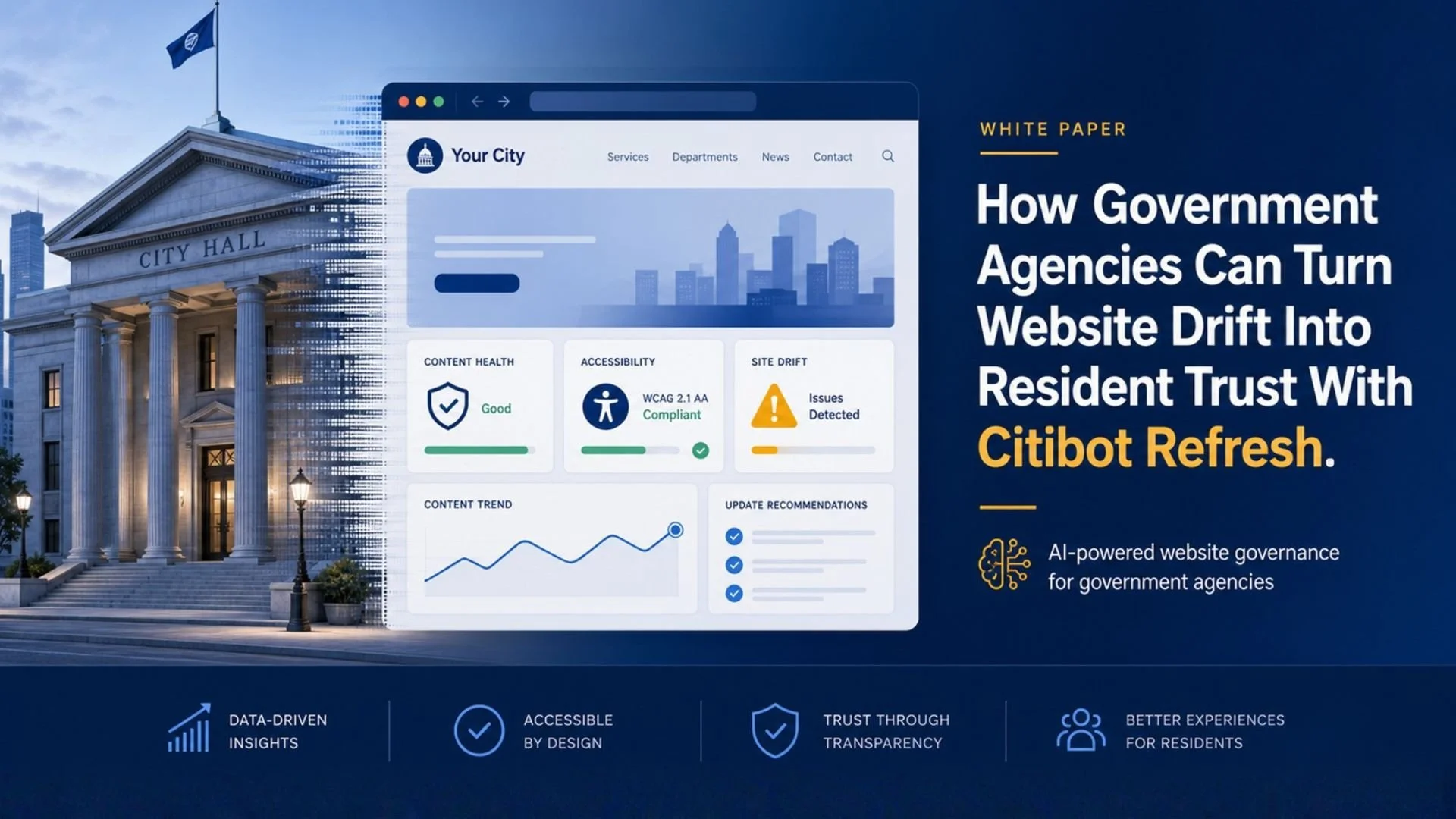
Citibot Refresh is positioned as an AI powered website governance platform built for government that continuously scans web content, flags outdated and inaccessible material, identifies inconsistent messaging, and recommends specific fixes so teams can improve quality without months of manual review. That positioning is important because it treats the website as a living operating environment rather than a static communications asset.
The Refresh concept surfaced repeatedly in Citibot's customer forum. Speakers described the product as a way to identify outdated content, conflicting information, broken links, and accessibility problems in PDFs and pages, while also helping agencies create an inventory of documents and organize remediation work by department. Leigh Krehling from the City of Opelika captured the appeal in practical terms, describing ADA work as initially overwhelming and then praising the platform as a one stop shop that also helps clean up the website.
What makes that approach compelling for government agencies is not simply automation. It is guided prioritization. Most agencies do not fail because they do not care about accessibility or content quality. They fail because the work is distributed, the inventory is incomplete, and the review burden is so large that every team waits for a perfect project that never arrives. A scanning and recommendation layer changes the starting point. It gives administrators a live map of what exists, what is broken, what is outdated, and what should be fixed first.
In effect, Refresh promises to move website management from episodic cleanup to continuous governance. This matters because websites decay continuously: staff change roles, ordinances are updated, service hours and fee schedules shift, linked documents move, and public messaging evolves during emergencies. Without a system that notices these shifts at scale, agencies are forced into reactive maintenance after complaints or legal concerns appear.
The Walled Garden as a Public Sector Principle
One of the sharpest distinctions in the panel discussion was the contrast between general purpose consumer AI and AI designed for government service delivery. Jonathan Wiersma described Citibot's approach as a “walled garden,” meaning the system is grounded in official and validated agency sources rather than pulling freely from the open web. For a public sector audience, that is more than a product description. It is a governance principle.
Government agencies do not need a digital assistant that improvises. They need one that protects institutional credibility. A creative answer that sounds plausible but is unsupported by official policy can misdirect a resident, increase staff cleanup, and weaken confidence in the agency itself. The walled garden approach is therefore not a limitation. It is the mechanism by which AI becomes usable in a high trust environment.
This principle also strengthens the case for Refresh. If web chat, text, voice, search visibility, and resident self service all depend on the quality of the underlying content, then content governance becomes the foundation for every downstream digital interaction. During the forum, Citibot emphasized that better website accuracy improves not only resident answers but also the performance of search and service channels built on the same source of truth. In this view, website governance is not separate from AI strategy. It is the prerequisite.
Why This Matters to Leadership Now
City Managers, Chief Information Officers, City Administrators, County Managers, and Communications Directors are all being asked versions of the same question. Can the digital front door be trusted at scale. The answer now affects legal exposure, service quality, staff efficiency, public confidence, and the credibility of broader AI adoption efforts.
That is why Refresh should be understood as a governance platform rather than a content utility. It helps agencies address three executive concerns at once.
First, it reduces hidden risk by surfacing inaccessible, outdated, and conflicting content before those issues become formal complaints or service failures.
Second, it improves operational efficiency by focusing staff attention on the pages and documents most likely to generate confusion or escalation.
Third, it supports Citibot's mission to build trust between governments and residents through accessible, AI powered communications, because trust depends on whether official information is both easy to reach and correct when found.
There is also a strategic timing advantage. Agencies that build continuous governance now will be better positioned to support web chat, voice, search, and self service expansion later. Agencies that postpone the work will find that every new digital channel exposes the same underlying weaknesses in content quality and accessibility.
A Different Standard for Modern Government Websites
The deeper message in Citibot's platform story is that modern government websites should be judged by a different standard. Not whether they were redesigned recently. Not whether they look polished on the homepage. Not whether analytics traffic is up. The real question is whether the site can continuously deliver accurate, accessible, and trusted information across departments and changing conditions.
Citibot Refresh speaks directly to that standard. It acknowledges that website decay is normal, that accessibility cannot be postponed, and that resident trust is built through thousands of small digital interactions that either confirm or undermine confidence in government. For agencies facing expanding service expectations and hardening compliance requirements, the path forward is not more manual review. It is better governance, informed by AI and anchored in official content.