The Government AI Buyer’s Guide: Start Where Residents Are. Grow Where the Data Points.
A practical guide for government teams evaluating AI service agents for chat, voice, and text.
Preview heading
The Four Ways Government AI Goes Wrong — and the Model That Works
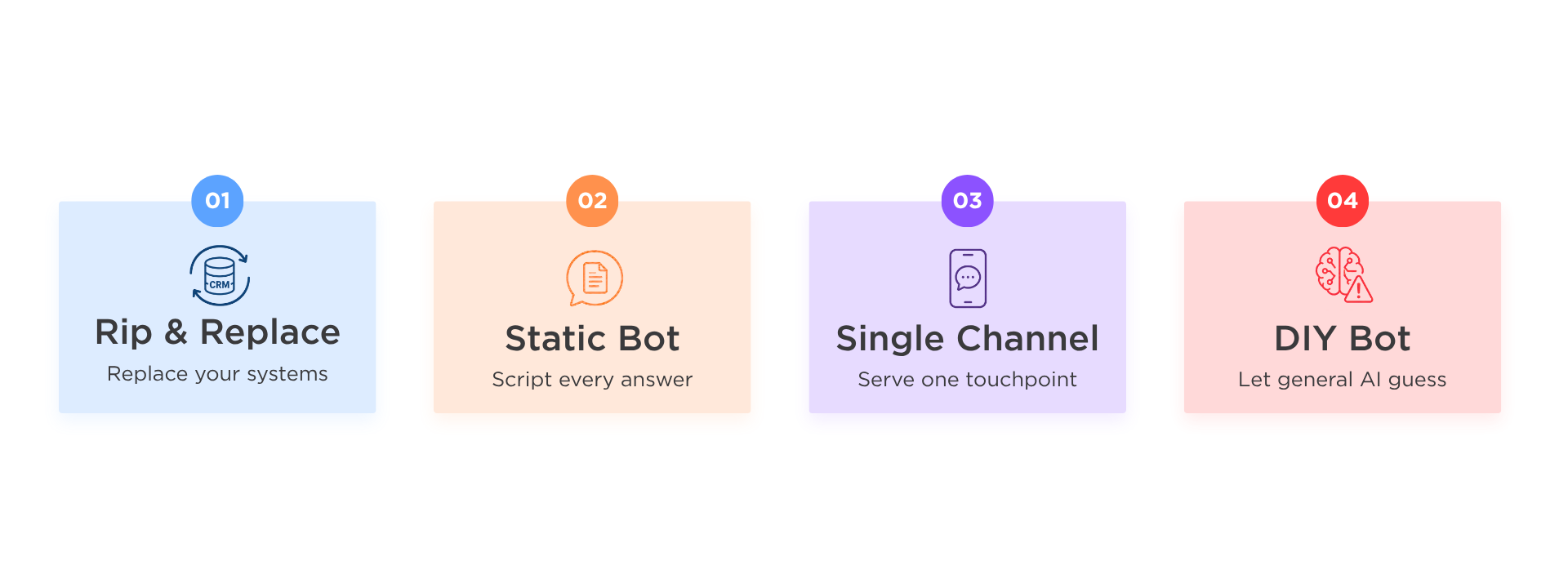
Trap 1: The rip-and-replace CRM
Some AI vendors are, at their core, CRM companies. Their chatbot and voice agents exist to pull you onto their CRM and workflow suite — so the pitch always circles back to consolidating your operations on their platform. It sounds tidy. In practice:
Not every department will switch. Public works keeps its work order system. Permitting keeps its land management platform. Police, parks, utilities, and finance each run tools chosen for their jobs, under separate contracts and budgets. A vendor-locked AI only serves the departments that convert — which means it never serves the whole resident.
Your 90-day AI project becomes a multi-year migration. Data conversion, retraining, and change management you never budgeted for — before residents see any benefit…..
Get the complete AI Buyers Guide
Learn what to ask vendors before you buy, how to avoid costly implementation traps, and what to look for in a government-ready AI solution.
What You’ll Learn
Avoid Common AI Traps
Recognize the approaches that create vendor lock-in, added maintenance, fragmented channels, or accuracy risks.
Evaluate the Full Service Layer
Understand what government AI should deliver across chat, voice, text, analytics, integrations, and more. The guide goes into those capabilities directly on pages 5–7.
Build on What You Already Have
See how AI can work with your existing content, CRM, GIS, permitting, work order systems, and other technology instead of replacing them.
Know What Questions to Ask Vendors
Use practical warning signs to identify limitations before they become expensive problems. The guide closes with six specific signs to watch for when evaluating a vendor or internal build.