
Case Study/Guide
What's New at Citibot and What it Means for Your Residents in 2026

Author: Art Gassan
Art Gassan is a govtech writer and AI practitioner with over 10 years of experience delivering technology solutions for government agencies. His work focuses on responsibly using AI to enhance public services, safety, and operational efficiency. A member of the GovTech AI advisory network, he co-authored the ebook “Navigating AI Regulations for Local Government” to help agencies adopt AI in a compliant and trusted manner.
Key summary
In 2026, government agencies must balance 24/7 service and strict compliance with the growing demand for private-sector-level responsiveness. Citibot 's latest suite - AI Voice, enhanced analytics, and the Refresh intelligence tool - transforms AI from a pilot experiment into a core utility. This white paper outlines a roadmap for city and county leaders to deploy a full-stack resident experience layer that scales services and improves accessibility without increasing headcount or compromising public trust.
Key Conclusions
AI-driven engagement is evolving from a niche project into the primary interface for city services. By modernizing legacy phone lines and websites with natural language tools, agencies are converting high-volume interactions into significant cost savings and faster response times. Citibot 's suite - including AI Voice and the Refresh website scanner - eliminates friction by providing 24/7 instant answers and identifying outdated content that erodes resident trust.
Success stories, such as Denver 's $500,000 savings over 18 months, prove that AI can handle over 25% of inbound calls while maintaining 90%+ satisfaction. Ultimately, these tools provide the leverage necessary to optimize staffing and digital priorities based on direct resident feedback.
Key quote
"We want to deliver the results that we are serving your residents and we want to deliver the results that we are saving you money." - Bratton Riley, CEO, Citibot
The New Baseline for Resident Expectations
For years, the story of digital government has been told in websites and mobile apps, but the daily reality for most residents still starts with a phone call or a search box and a simple question. Do I need a permit for this fence? When is my trash collected? How do I report a pothole? Each of those questions carries a surprising amount of friction when the answer depends on outdated content, fragmented systems, and staff who are already stretched thin.
By 2026, residents increasingly judge their government by the ease of that first contact. They compare their city or county not only to neighboring jurisdictions but to streaming platforms, banks, and retailers that serve them with instant recommendations and human-like chat across channels. As Citibot CEO Bratton Riley puts it in a recent webinar, the challenge is no longer whether to use AI, but "how AI can help government agencies" in a way that fits their constraints and values rather than overwhelming them.
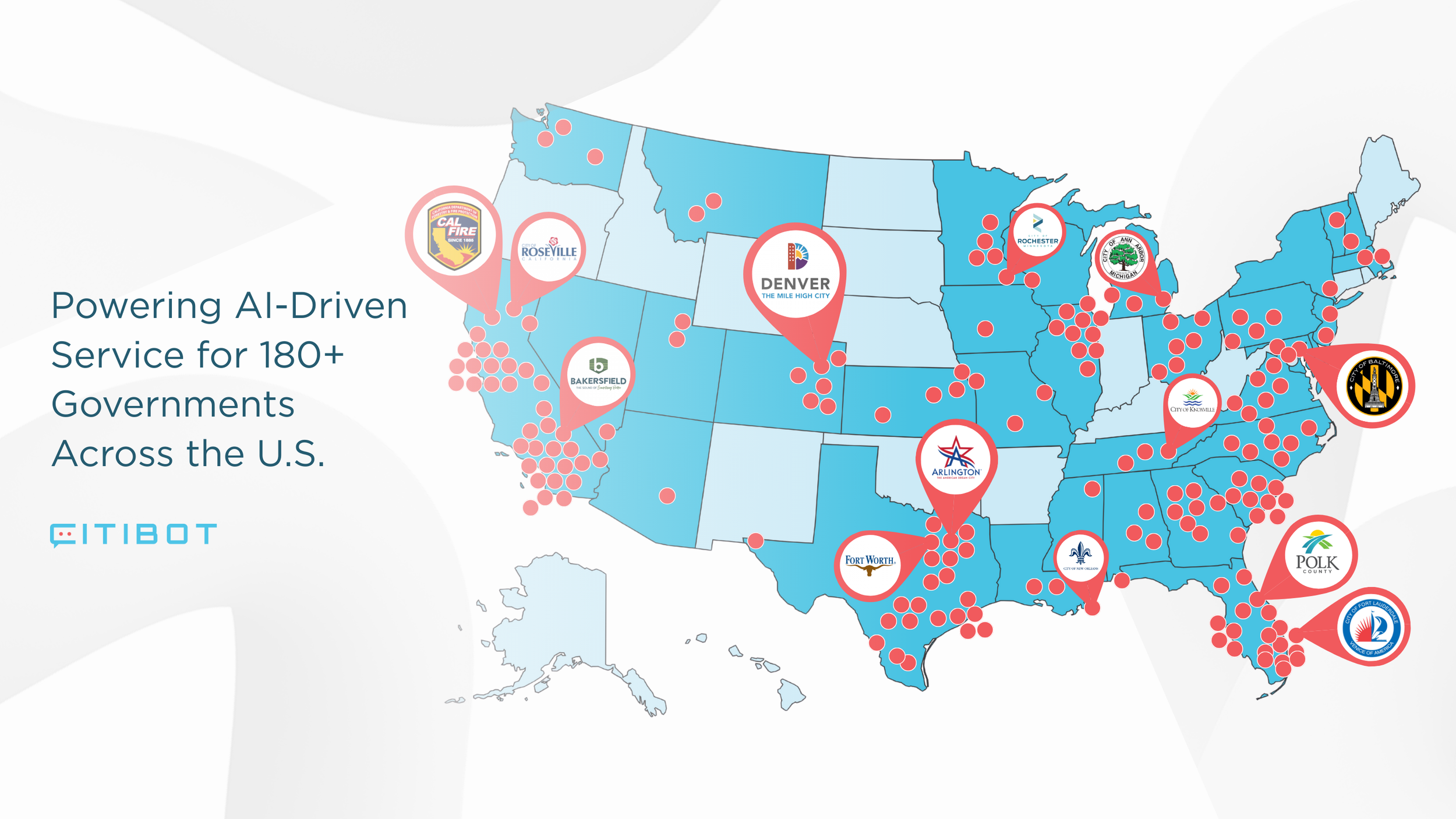
That shift explains why Denver's move to introduce an AI assistant nicknamed Sunny did not stop at a web widget. In less than two years, Denver's Citibot deployment helped the city handle over 25 percent of inbound calls with AI while keeping resident satisfaction above 90 percent and limiting back end administration of the AI assistant to a single part time specialist. The result is not just faster service, it is a political signal that the city is listening around the clock and investing staff time where it matters most.
The City of Arlington, Texas, heard a similar drumbeat from its elected officials and leaders. “With internal pressure to adopt AI mounting, Citibot 's solutions are an ideal fit,” said Jay Warren, Arlington 's Director of Communication and Legislative Affairs.
Showing council members a working AI Assistant and the engagement data behind it became a way to demonstrate that the city was not just following a trend but deploying technology in a disciplined, high impact way.
These stories underscore a quiet realignment. AI chat is no longer an experiment at the edge of the website; it is becoming the default way residents ask for help and the main instrument agencies use to see what their public is actually experiencing.
From Chat to Voice Why Phone Lines are the Next Frontier
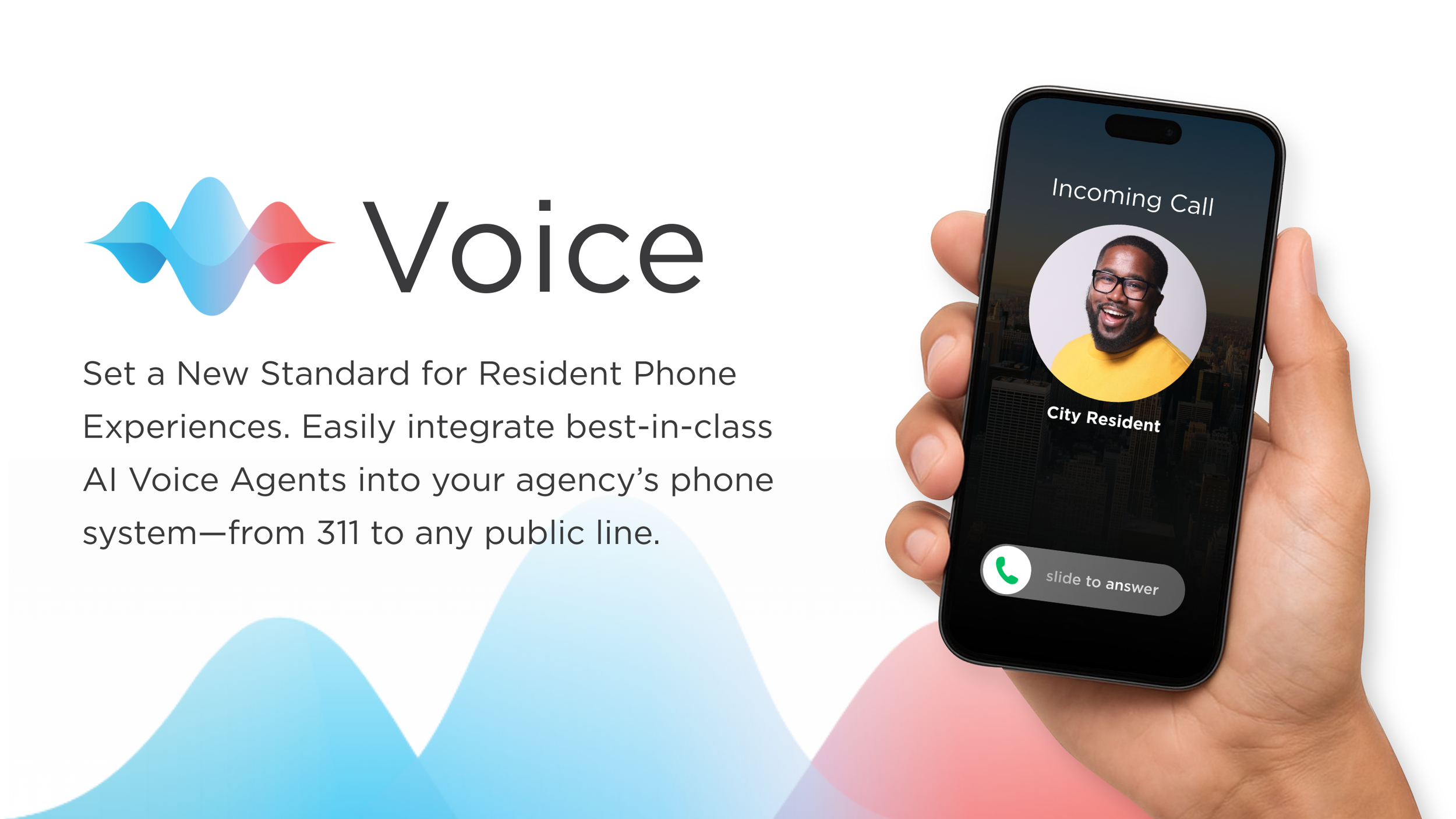
If web chat was the first wave of AI powered resident interaction, voice is the next and perhaps the most disruptive. For many agencies, the phone remains the primary front door because large portions of the population still default to a call when something goes wrong or when trust in digital channels is fragile. Yet the mechanics of that experience have barely changed "Press 1 for this, press 2 for that" even as call volumes swell and budgets tighten.
Citibot's AI Voice is designed to replace or augment those traditional IVR trees with a conversational layer that sits on top of the existing Citibot platform. Residents call the same numbers they already know for 311 or departmental lines and instead of navigating a rigid menu, they simply say what they need in their own words and are either answered directly, routed to the right queue, or invited to submit a service request. Behind the scenes, Citibot maps those natural language queries to the same knowledge base and workflows that power web chat and text, so agencies are not juggling separate sets of rules.
Bratton defines AI Voice as a “high-quality, AI-powered agent” designed for more than just novelty: the goal is total parity with human operators on every routine call.
Citibot can even point existing phone numbers to the AI platform without changing infrastructure, creating a soft transition where residents experience better service without needing to learn a new entry point.
Consider the pressure on a public works department during a missed pickup event or a storm. With AI Voice running on a main number, hundreds of residents can report issues, receive confirmation numbers, and in some cases be offered immediate scheduling updates, all without waiting on hold.
Data, Sentiment, and the New Analytics Fabric
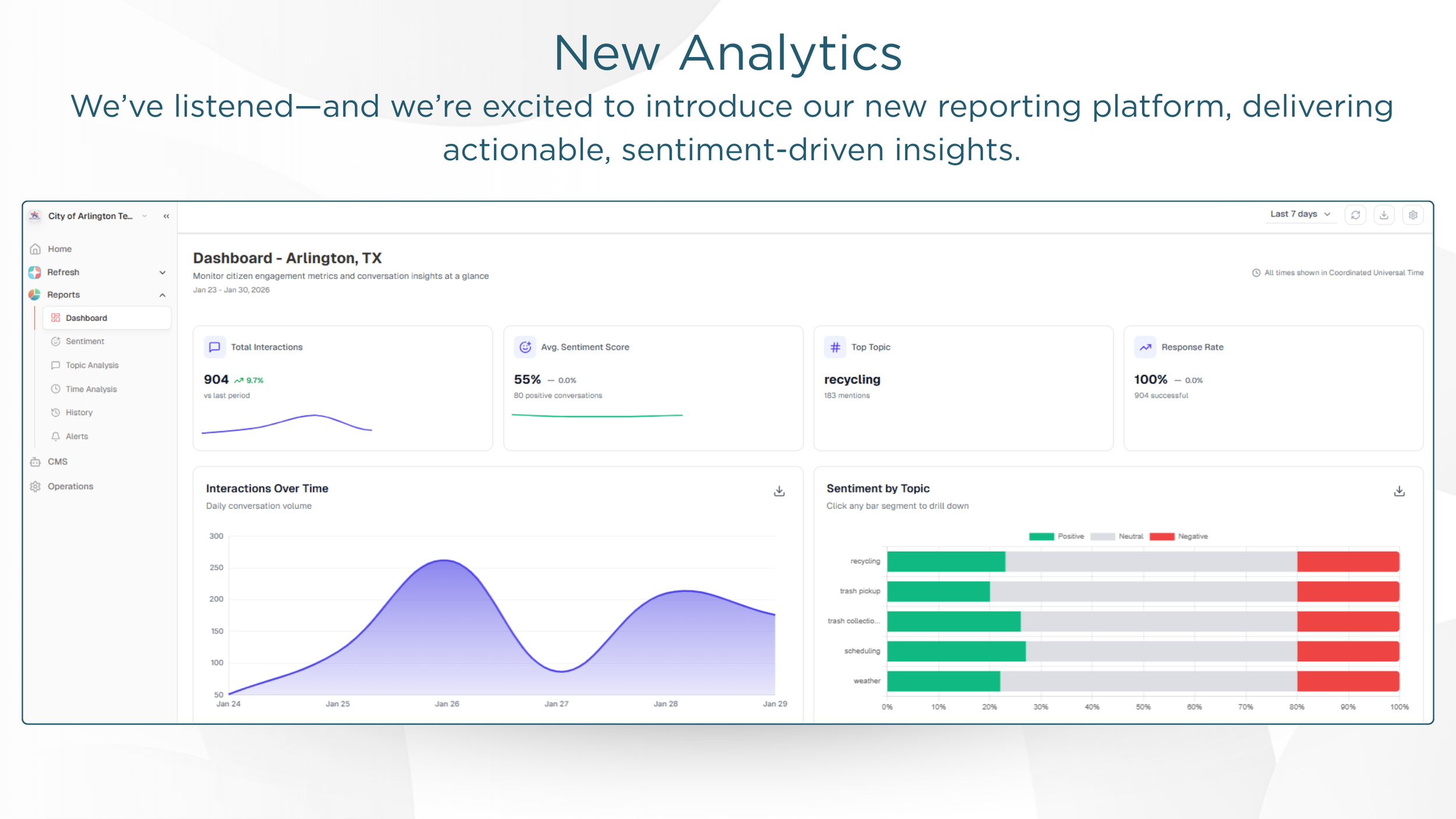
For years, call centers and 311 systems produced reports sorted by category and count, but they rarely captured the emotional texture of what residents were saying in real time. Citibot's upgraded analytics dashboard is an attempt to close that gap by overlaying sentiment, topics, and time frames on top of the raw conversation stream.
Jordan Schinstock describes the ambition this way: “By capturing everything from compliments to complaints and the middle majority, agencies gain a 360-degree view of resident sentiment.”
The objective is to move agencies beyond anecdotes, one angry email, one viral social media thread and toward decisions rooted in thousands of AI mediated conversations happening every week.
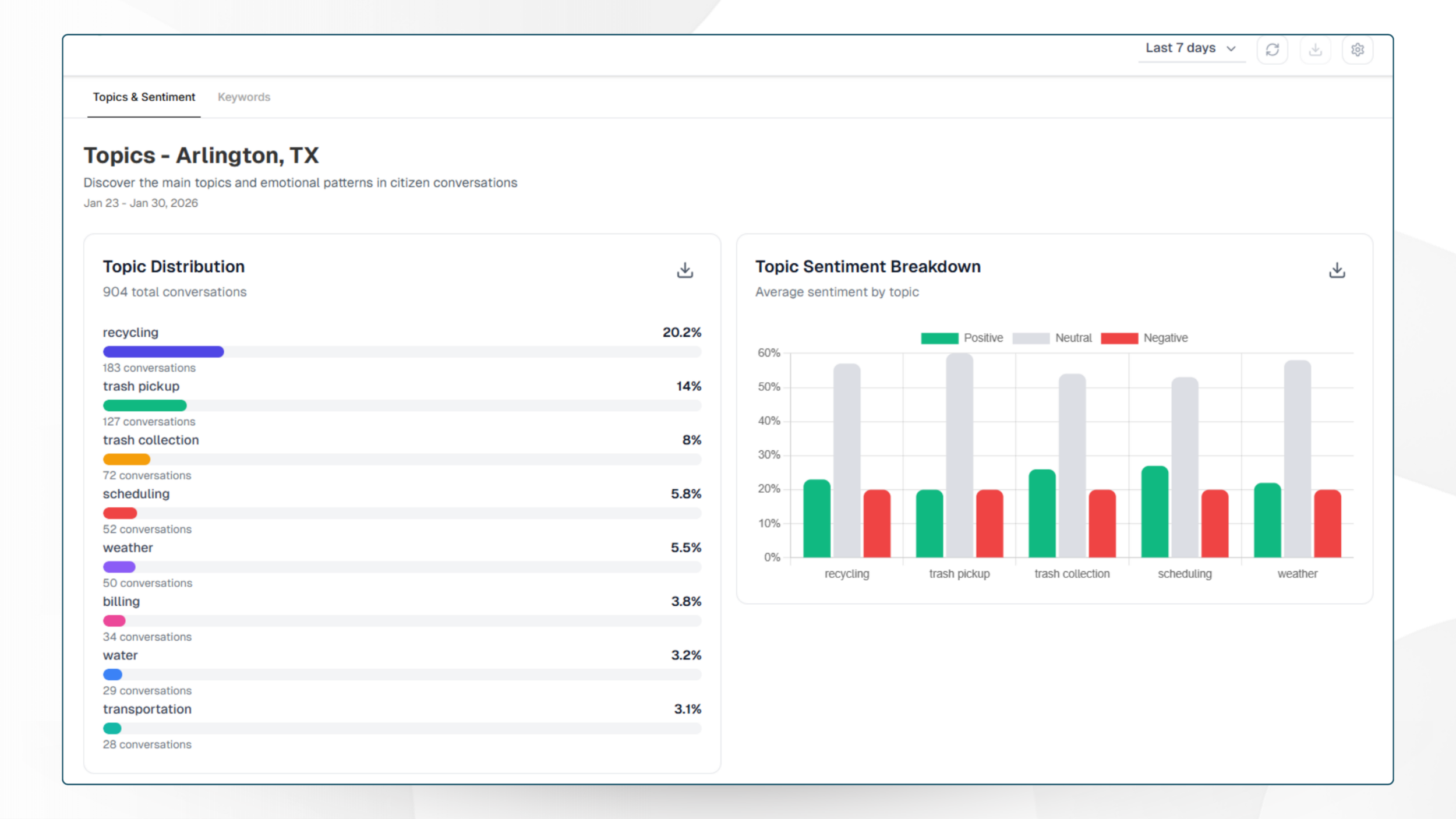
The new dashboard, provided at no additional cost to Citibot customers, turns that stream into operational insight. Leaders can see when spikes in trash questions map to missed routes, when confusion around a new ordinance is concentrated in a particular neighborhood, or when website content is failing to answer frequent queries, often within days of a change. Over time, those patterns become an early warning system for friction that might otherwise appear months later in satisfaction surveys or council meetings.
Denver's experience offers a glimpse of what this looks like in practice.
Laura Dunwoody, the city's Director of Technology Services for Resident Experience, explains that with Citibot, "We can now give our agency customers specific questions residents are asking and pinpoint exactly what website content needs updating, making our discussions shorter and more productive."
Instead of broad debates about whether a department is doing enough outreach, her team brings transcripts and trends that show exactly where answers are failing and how updated language changes the flow.
This feedback loop changes internal culture. Meetings that once relied on hunches become grounded in the language residents actually use and the complaints they repeat. IT and communications staff gain leverage because they can demonstrate that a fix to one paragraph on a page or an adjustment to a workflow will likely reduce a measurable slice of calls or chats. In effect, Citibot's analytics recast AI not only as a front line service but as a kind of observatory for the lived experience of public services.
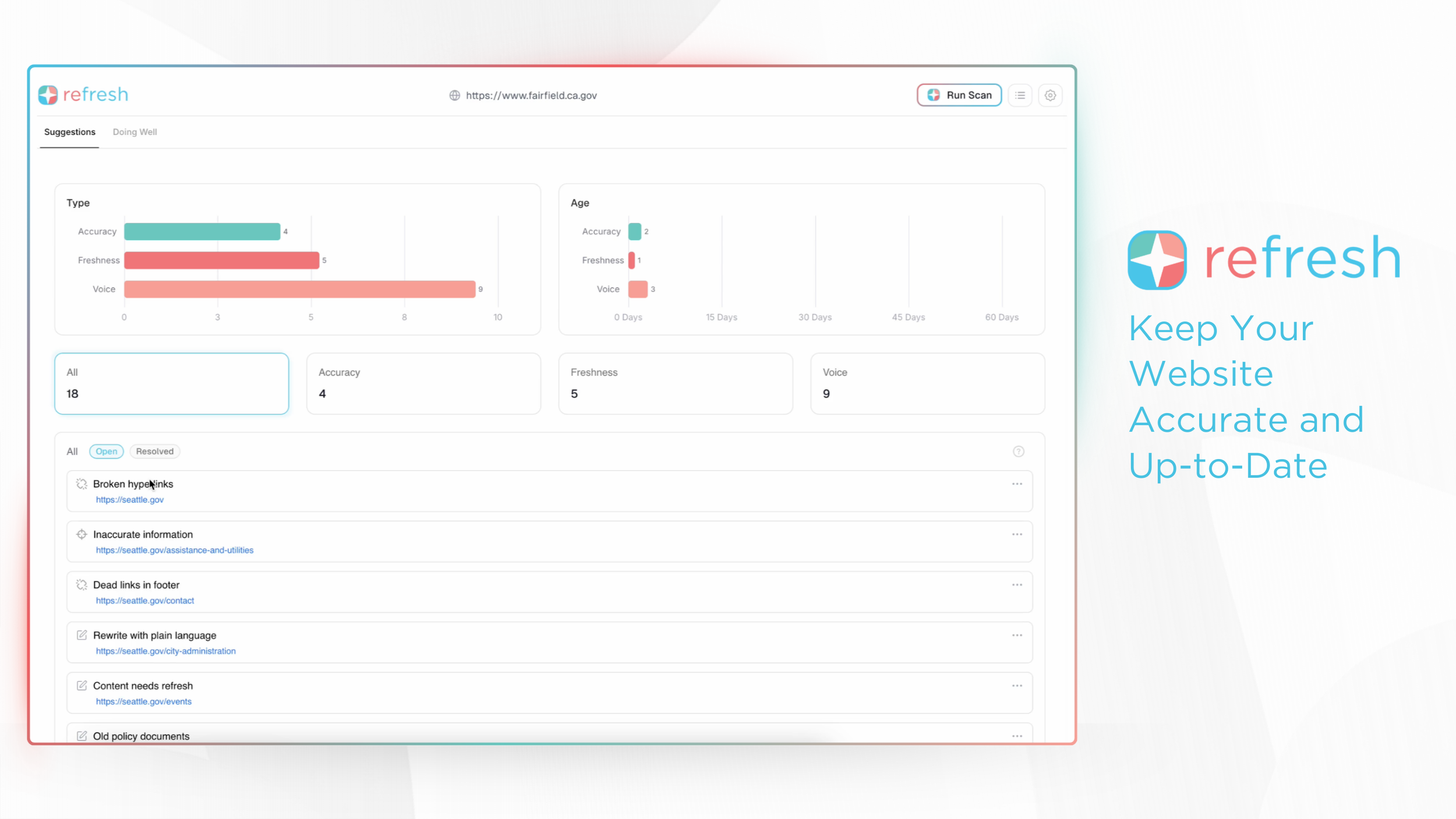
Refresh and the Battle Against "Old as Dirt" Content
Every digital leader in government knows the problem of content drift. Pages created years apart contradict each other. PDFs linger with expired dates. Different departments speak in different voices about the same program. Residents bump into broken links and outdated instructions and draw the only conclusion they can: this agency is not paying attention.
Refresh uses AI to scan government websites and PDFs for outdated content, inaccuracies, conflicting information, broken links, and accessibility gaps, all while scoring pages across four pillars: accuracy, current, persona, and accessibility. Rather than relying on staff to manually audit hundreds or thousands of pages, agencies receive prioritized lists of issues and specific locations to fix.
The timing is not incidental. New accessibility regulations will require cities and counties above certain population thresholds to show progress toward WCAG 2.1 compliance by 2027, with large jurisdictions needing to demonstrate they are "well on their way" by April of this year.
Practical Roadmap for 2026 and Beyond
First, establish a strong AI chat foundation across web and text focusing on one or two high volume service areas such as public works or permitting and using Citibot's full service approach to minimize IT lift. Early months should emphasize content curation and governance ensuring that the knowledge base reflects current policies and that internal teams understand how residents are using the new channel.
Second, take a deliberate deep dive into the enhanced analytics dashboard and start weaving sentiment and topic trends into regular leadership conversations. Use those insights to review content at scale and prioritize website edits, policy clarifications, and internal training rather than waiting for annual reports or survey cycles. As Schinstock’s framing suggests, the goal is to move from guessing to knowing, and from isolated anecdotes to patterns that can guide investment
Third, expand into AI Voice by routing existing high volume phone lines into the Citibot platform, starting with after hours coverage or specific departments that are struggling with call volume. Communicate clearly with residents about the change, emphasizing that they can still reach staff when needed, but that the agency is introducing a faster option for routine questions and requests.
Finally, bring chat, Voice, analytics, and Refresh together as a single resident experience layer rather than separate tools. When your AI assistant, phone lines, and website all run on the same Citibot platform, you can use WCAG 2.1 oriented scans and persona scoring to keep content accurate and accessible while every channel delivers consistent answers and eliminates the old as dirt contradictions that frustrate residents and confuse AI alike.
Throughout this progression, the central discipline is to treat AI not as a black box, but as a strategic extension of institutional record and trust. This requires owning the data, curating the content, and measuring success by outcomes that matter - faster answers, fewer handoffs, and clearer explanations - rather than technical novelty alone.
Citibot 's 2026 platform provides the essential fabric for scalability and resilience. By automating complex interactions and ensuring every response is accurate and accountable, the platform removes the operational bottlenecks that stifle expansion. Cities and government agencies that move early to integrate this technology will not only meet rising expectations but will unlock the efficiency and responsiveness required to redefine their market position and accelerate long-term growth.