How Prince William County Built a More Trusted Resident Experience With Citibot
Author: Mary Frances Coryell, CGCIO
Mary Frances Coryell stands at the forefront of government technology as Chief Revenue Officer at Citibot, an AI-powered chat solutions leader serving government agencies nationwide. She brings nearly a decade of experience driving municipal digital transformation and fostering trust between governments and residents. Coryell's work has facilitated data-driven improvements across California and beyond, earning recognition for advancing innovation in resident engagement, accessibility, and operational efficiency.
Key Summary
Prince William County did not set out simply to launch an AI assistant. It set out to make government easier to reach, easier to understand, and more accountable to the people it serves.
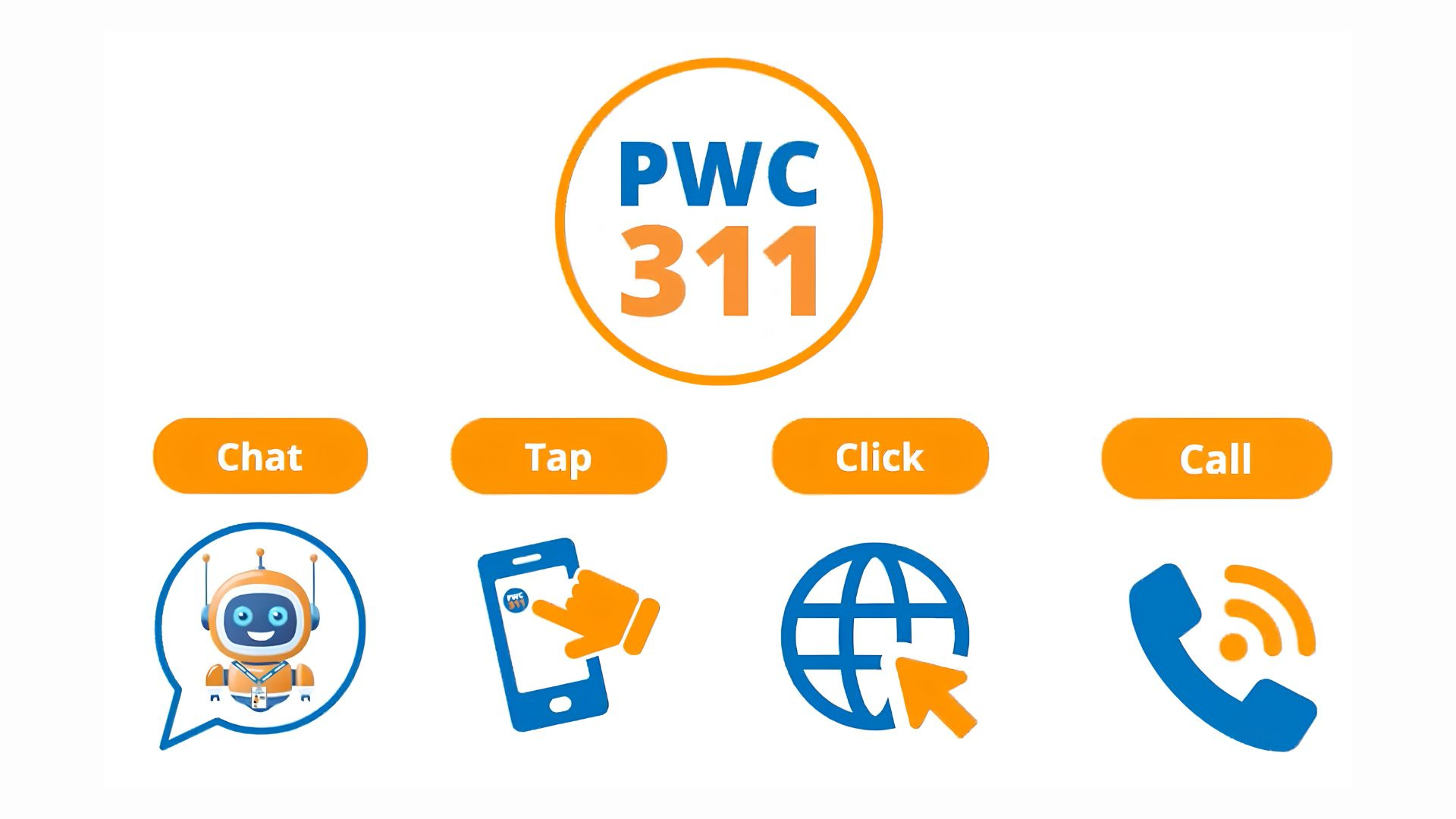
The County created a centralized 311 experience that gives residents a single, reliable point of entry for information and non-emergency service requests. That entry point can be a phone call, web chat, email, text, mobile interaction, or AI voice conversation. Behind those channels is a coordinated system designed to replace fragmented departmental interactions with a more consistent resident experience.
Citibot plays a central role in that system. Through Will, the County's AI chatbot, and Willow, its AI voice capability, Prince William County provides 24/7 access to trusted information and service-request pathways. The County has used Citibot data to identify content gaps, reduce unanswered questions, create new service categories, improve website information, and strengthen accountability across departments.
The early results show the power of an intentional, data-driven approach. Prince William County launched with 35 service requests and more than 800 knowledge articles. It expanded to 50 service requests, reported more than 64,000 AI interactions without significant advertising, and reduced its AI apology rate from 25 percent to 11 percent through continuous content and process improvement.
The lesson for other government agencies is clear. AI can help deliver a better resident experience, but only when leaders treat it as a living service system rather than a one-time software deployment.
Key Conclusions
Prince William County used Citibot to create a unified 311 front door that meets residents across web, chat, phone, email, text, and mobile channels while directing interactions into a consistent operational model.
The County's most significant challenge was not technical deployment. It was building alignment across departments, clarifying service processes, and creating a shared commitment to resident outcomes.
Citibot AI provided more than answers. It gave Prince William County a source of real-time resident insight, showing where content was unclear, where services were missing, and where residents needed new pathways to action.
Prince William County improved its Citibot AI apology rate from 25 percent to 11 percent by treating unanswered questions as a content, accessibility, indexing, and service-design signal.
The County used evidence from Citibot conversations and General Requests to guide expansion, growing from 35 to 50 available service-request types and building a roadmap toward 100.
AI enabled the County's human service teams to spend less time on repetitive questions and more time resolving complex, high-empathy resident needs.
"We wanted to provide county residents with a single reliable platform accessible through a variety of doors, but all leading to the same place."
- Katherine Hanson, 311 Operations Technical Lead, Prince William County
The Problem: Too Many Doors
For many residents, government does not feel like one institution. It feels like a collection of doors, each marked by a different department, office, form, phone number, website, or email address. A resident with a simple question may not know which door to choose. A resident with a service need may not know whether to call, search the website, submit a request, send an email, or visit an office.
That fragmentation creates more than inconvenience. It creates uncertainty. It places the burden of navigating government on the person who needs help from it.
Prince William County recognized that its residents needed a more coherent way to interact with County government. The County's answer was not to erase departmental expertise or centralize every decision. It was to create a unified 311 model that could make the experience of accessing information and services feel more consistent, regardless of where the interaction began.
The County’s vision was to make 311 the primary point of contact for general information and service requests. Its operating model rests on four pillars: deliver a centralized solution, provide broad access across multiple channels, provide transparency through updates, and track requests through to a meaningful outcome.
This is a significant departure from the traditional model in which residents are sent from department to department and must independently determine where their issue belongs. In Prince William County's model, residents can begin with the need they have. The County then uses its people, processes, systems, and Citibot capabilities to help them find an answer or take action.
Katherine Hanson described the deeper purpose of the program with characteristic clarity: "We wanted to simplify access to service while ensuring government transparency and promoting agency accountability."
The Solution: A Single Front Door Powered by Citibot
Prince William County's 311 environment gives residents multiple ways to connect with County government. Residents can call, chat, email, use a mobile experience, submit a service request, or engage through AI voice. The important design principle is that these are not disconnected channels. They are different doors that lead to the same service ecosystem.
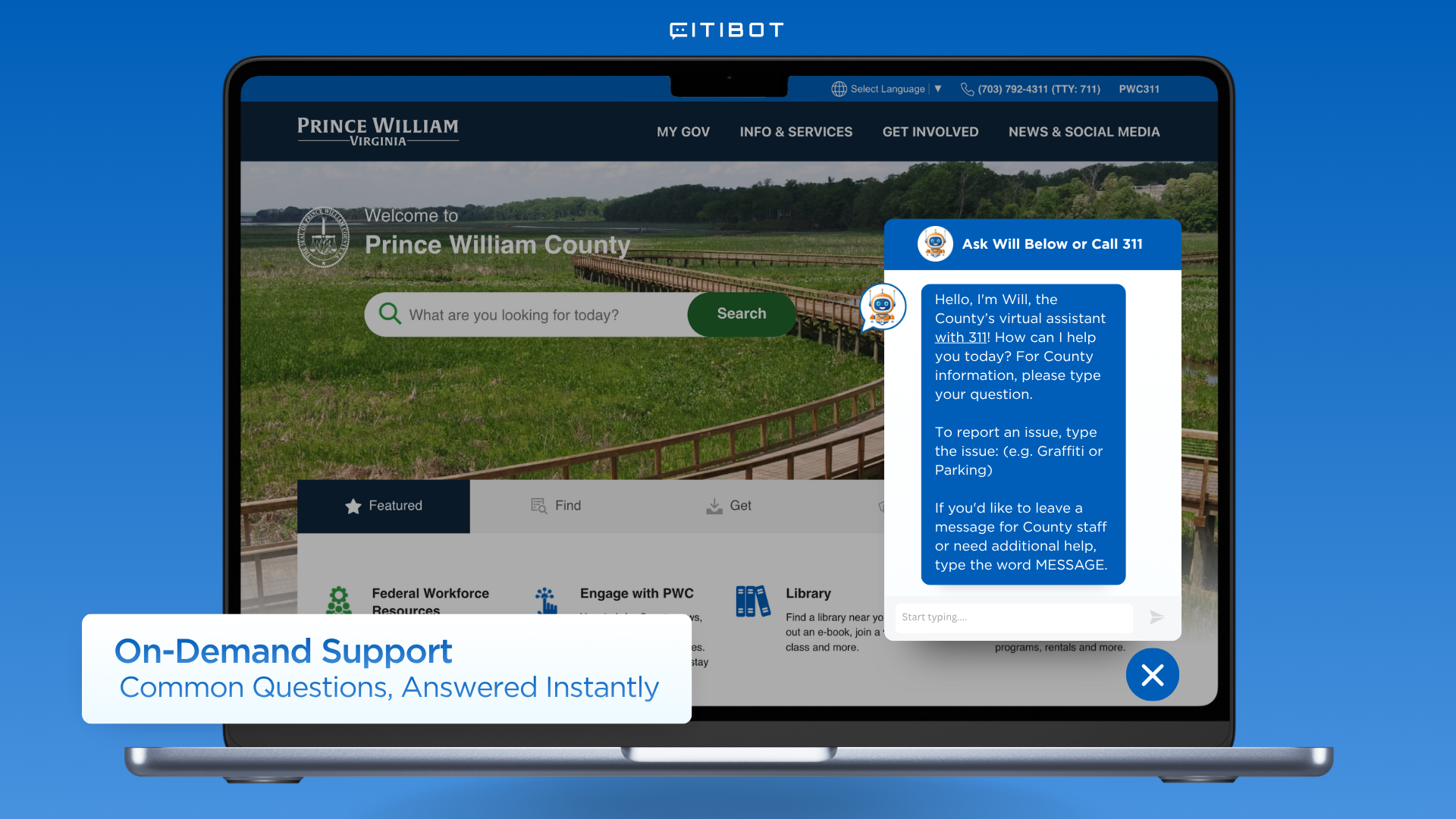
Citibot's AI chatbot, Will, is available throughout the County website and provides an always-on entry point for residents seeking information or help. Instead of requiring residents to start at a dedicated 311 page, the County places Will where questions naturally occur: on the pages residents already visit. A resident researching property information, animal services, public works, jury duty, or another County topic can ask a question in the moment, without leaving the page to search a separate system.
Will uses trusted County resources and a controlled knowledge base rather than open-ended public web information. This is crucial in government, where an answer that sounds plausible but is not authoritative can cause real confusion. Prince William County uses scheduled website data updates, with more frequent refreshes for time-sensitive areas such as jury-duty information.
The County also introduced Willow, an AI voice experience that can help handle after-hours calls. This extends the County's service model beyond the traditional limits of office hours and conventional interactive voice response systems. Rather than forcing a caller to navigate a rigid menu structure, AI voice can help interpret the resident's intent, provide information, and guide them toward a next step.
The technology, however, was only the visible layer. The more difficult work took place inside the organization.
"The technology was probably the easiest part," Hanson said. "The bigger challenge was getting the organization of Prince William County Government ready for 311."
That statement should resonate with government leaders who have watched promising technology programs stall because they were not matched by clear process ownership. Prince William County brought departments into the work early. Teams needed to define what they offered, establish consistent intake questions, clarify expectations, and identify how a request would move from initial contact to resolution.
The County did not wait until every department and every service was perfectly ready. It launched with 35 core service-request types and expanded from there. This approach created a practical foundation while preserving space for learning, iteration, and evidence-based growth.
The Insight: Every Question Is Data
One of Prince William County's most consequential decisions was to view Citibot interactions as a source of resident intelligence.
Before a centralized AI-enabled 311 environment, government agencies often rely on fragmented signals to understand resident needs. Staff hear recurring questions at the counter. Department leaders receive emails. Communications teams monitor social media. Elected officials receive calls from constituents. Each source has value, but none offers a complete and structured picture of what residents are trying to accomplish.
Citibot changes that equation. Each interaction with Will can show the County what residents are looking for, where they are experiencing confusion, what language they use to describe a problem, and what information is missing from the public experience.
As Drew Messick, Data and AI Engineer at Prince William County, explained, "We take that data and learn where the process should go. We go where the data leads, always aiming to meet our community's needs."
This is not merely an analytics advantage. It is a different way of governing the service experience.
A resident who cannot get an answer from an AI assistant may expose an outdated page, a poorly indexed document, incomplete web content, an accessibility issue, a missing workflow, or a service category that does not yet exist. In a mature program, that interaction is not dismissed as a failed conversation. It becomes a work item for improvement.
Prince William County uses an internal measure called the apology rate, which captures situations in which the AI cannot provide a useful response. Rather than accepting these moments as inevitable, the County examined why they occurred. Teams looked at the quality of the content, the availability of information on the website, search and indexing behavior, and how dynamic web pages were being captured.
That sustained work reduced the County's apology rate from 25 percent to 11 percent.
The number is meaningful because it represents a shift from passive information publishing to active website and service governance. The County did not simply ask whether Will was answering questions. It asked what those unanswered questions could teach the organization about its own public information.
The same mindset shaped how Prince William County uses General Requests. This category captures issues that do not yet fit into a dedicated service path. In many organizations, "other" becomes a dead end. In Prince William County, it became a discovery engine.
When residents repeatedly submitted General Requests about a common topic, the County had evidence that the existing service structure did not match resident needs. That evidence informed new service-request development, including work related to animal services and seasonal demand such as snow removal.
The County's method is a useful model for City Managers, County Managers, CIOs, and Communications Directors. Government agencies do not have to guess which services to digitize next. They can listen to the requests residents are already making and use that demand to prioritize the next improvement.
The Results: More Access, Better Information, Stronger Accountability
Prince William County's implementation shows that an AI-enabled 311 program can produce results across several dimensions at once: resident access, staff capacity, information quality, service design, and organizational accountability.
The County launched its 311 system with an initial foundation of 35 service-request types and over 800 knowledge articles. Since then, we have expanded to 50 service types, with six additional services currently in development. While our long-term roadmap targets a total of 100 service types, we are taking a disciplined, phased approach to this growth. By prioritizing a meaningful initial set of services and allowing actual resident demand to guide our expansion, we ensure that each new addition provides genuine value to the community.
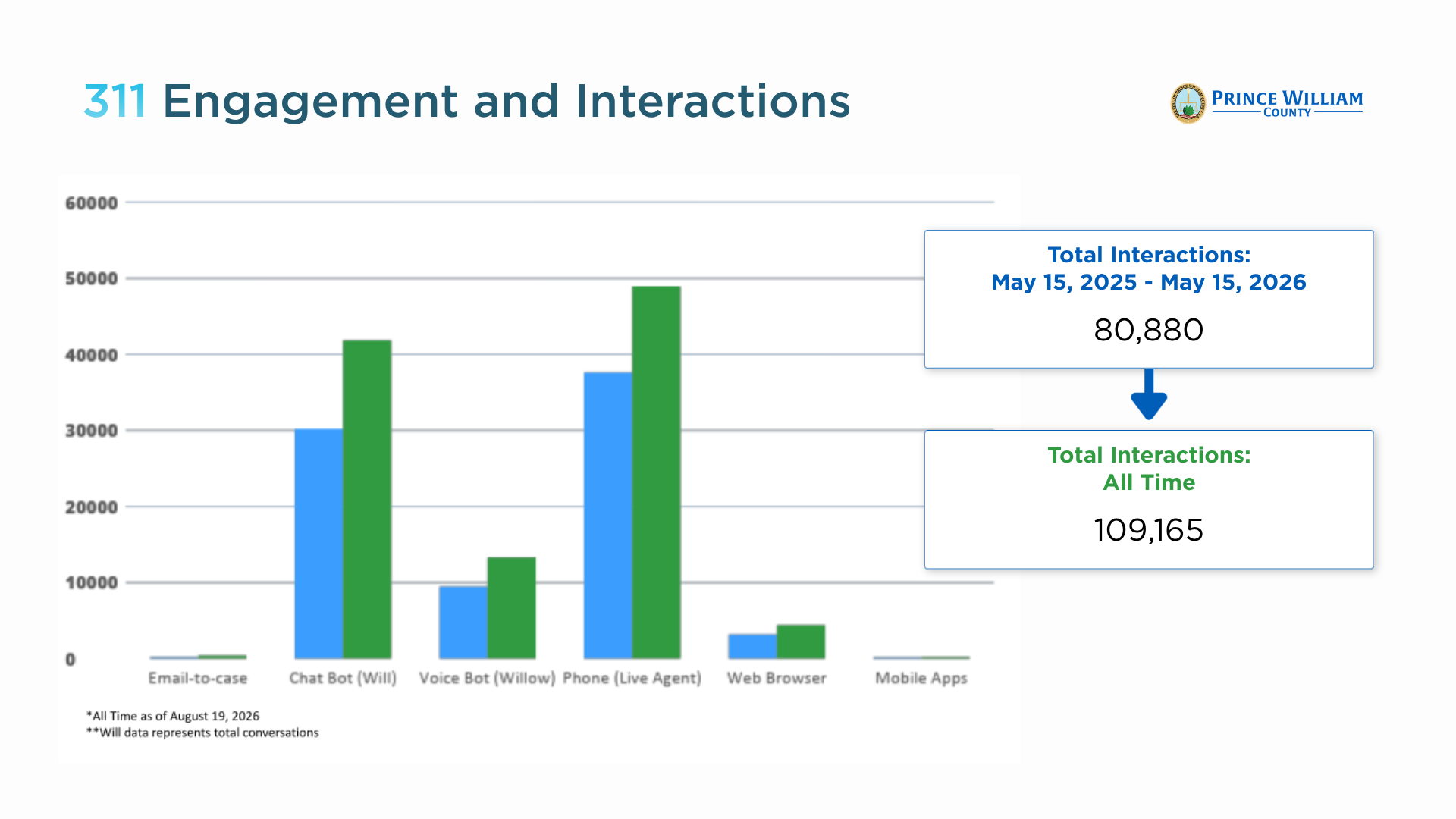
The County also reported more than 64,000 interactions with Will despite doing little to no advertising for the AI experience. That volume is significant not merely as a measure of usage, but as evidence that residents will adopt a useful service channel when it is integrated into the places they already go for information.
Messick described the pattern directly: "One thing we'll note is we have done little to no advertisement about Will, and yet we have 64,000 queries since we went live."
Citibot helped Prince William County deliver access beyond standard business hours and beyond a single mode of communication. Web chat supports residents who prefer self-service. Voice AI provides an option for callers who need help outside regular office hours. Email, mobile, text, and phone routes give residents flexibility. Each channel matters because resident needs are not uniform.
The program also strengthened the County's capacity to provide meaningful human service. The AI handles repetitive questions, such as hours, basic service details, status inquiries, and frequently requested information. This allows call-center analysts and department staff to devote more time to issues that require judgment, empathy, problem-solving, and a deeper conversation.
Hanson emphasized the County's people-first approach: "My directive to my team is that you can take up to 10 minutes on a call and if you need longer, just let the rest of the team know. We can get people the help that they need and make sure that they're heard."
That is one of the most important lessons in the Prince William County story. The point of AI is not to make government agencies less human. It is to make human attention more available where it is most needed.
The County has also built accountability into the lifecycle of a request. A resident's issue is not considered complete simply because it has been passed from 311 to another department. Prince William County tracks service requests at 30, 60, and 90-day intervals and provides updates when work remains unresolved.
For residents, this reduces the sense that a request has vanished into a bureaucratic black hole. For leadership, it creates visibility into where requests slow down, where service expectations need attention, and where cross-departmental coordination can improve.
What Other Government Agencies Can Learn
Prince William County's experience provides a practical model for other government agencies considering Citibot or an AI-enabled resident-service strategy.
The first lesson is that organizational alignment comes before scale. The County's leaders did not treat 311 as an IT project alone. They made it a shared government initiative, bringing departments together around common service definitions, intake processes, responsibilities, and service-level expectations. This required a leadership mandate and sustained collaboration. It also required accepting that some departments would be ready earlier than others.
The second lesson is that content is not background work. It is the foundation of AI accuracy. Prince William County's investment in more than 800 knowledge articles gave Will a trusted information base from which to serve residents. Government agencies that want reliable AI should begin by asking a basic question: Is the information we publish clear, current, accessible, and owned by someone accountable for it?
The third lesson is to start with a defined scope and learn quickly. Prince William County began with 35 core service requests, not every imaginable use case. This approach allowed the County to establish its operating model, identify gaps, collect data, and expand based on evidence.
The fourth lesson is to treat unanswered questions as a strategic asset. A missed answer can reveal a website issue, an outdated document, a missing service, or a resident need that government agencies have not yet recognized. The County's reduction in AI apology rate from 25 percent to 11 percent demonstrates what happens when teams turn conversational gaps into content and service improvements.
The fifth lesson is that residents want transparency as much as speed. A service request that takes time can still create trust if the resident knows it was received, understands what happens next, and receives credible updates. Prince William County's 30, 60, and 90-day follow-up model reinforces that accountability does not end when a request leaves the 311 team.
Finally, the County's story shows that AI should reinforce, not replace, public service values. The strongest systems do not push residents away from people. They reduce avoidable friction so employees can focus on the conversations where human care, expertise, and discretion make the greatest difference.
A Model for Resident Trust
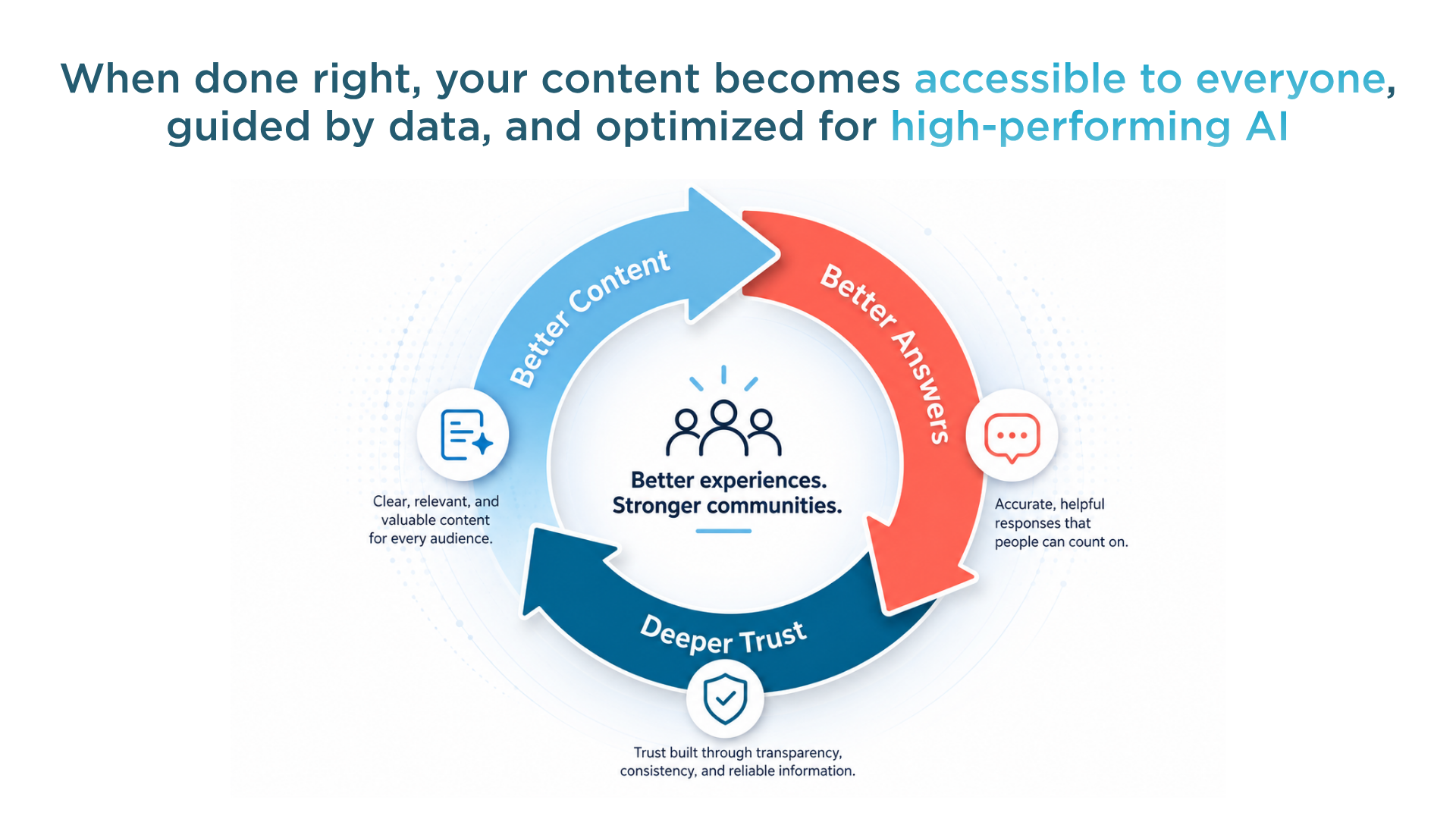
Prince William County's Citibot story is ultimately a story about trust built through repeated, practical interactions.
A resident comes to the County website with a question and finds Will ready to help. A resident calls after hours and receives guidance rather than a dead end. A resident submits a General Request, and the County recognizes a pattern that leads to a new service. A resident waits longer than expected and receives an update instead of silence. A staff member spends less time answering a routine question and more time helping someone navigate a difficult problem.
None of these experiences is dramatic on its own. Together, they define whether residents perceive government agencies as accessible, attentive, and capable.
Bratton Riley summarized the central principle: "The data is really clear that if you create positive experiences, they will trust you more."
Prince William County has shown what that looks like in practice. It established a unified 311 front door. It used Citibot to make trusted information available across channels. It built a feedback loop from resident questions to service improvements. It treated unanswered questions as evidence. It gave employees more capacity for meaningful work. And it created a model of accountability that follows a request beyond the first handoff.
For government agencies seeking to improve resident experience, the message is not that AI alone will solve every service challenge. The message is more useful than that.
Build a strong service foundation. Make accurate information easy to find. Listen to what residents ask. Use the data to improve. Give staff the tools to focus on people. And ensure that every door leads somewhere useful.
Prince William County's work with Citibot demonstrates that when government agencies do those things consistently, AI becomes more than a digital feature. It becomes part of a more responsive, transparent, and trusted way of serving residents.